
When People Have a Choice, Who Will Choose the Hardest Jobs?

The job is more than the wage
A young person considering a career in painting is choosing more than a daily wage. They are choosing how their body will be used, where they will live, how often they will see their family, whether earnings will continue next month, and what the occupation might offer ten years later.
That is an unusually revealing way to look at the labour question. An industry may need workers. The workers must still have reasons to choose the industry.
Painting makes this tension visible because the apparent simplicity of a finished wall conceals the complexity of producing it. Surface preparation, material selection, application and finishing require learned judgement. India's occupational standards recognise distinct skills in preparing surfaces, applying coatings and working with access equipment. A person available for employment is not automatically a painter who can reliably deliver a specified finish.
The work can also demand repeated arm movements, awkward postures and long periods overhead. Sanding creates dust; ladders and scaffolding introduce access risks; outdoor work can expose workers to heat. Coatings and spraying can add chemical and airborne exposure risks, depending on the material, method and ventilation. None of these burdens is identical everywhere, but together they help explain why painting can be a difficult occupation to choose and sustain.
There is another difficulty that a photograph of the finished room cannot show. A painter can arrive at a flat where preceding work remains incomplete. The worker cannot solve that dependency by applying paint faster. If usable work is scattered across rooms, floors or sites, productive time can disappear into waiting, movement and repeated preparation. Near handover, the same worker may then face intense pressure to correct highly visible defects.
This matters because the worker often bears the consequences of decisions made elsewhere in the construction process.
Employment arrangements can add another layer. Research involving migrant construction workers and micro-contractors in Bengaluru and Delhi has documented difficult working and living conditions. Even where the daily wage appears acceptable, workers still compare the entire employment package: continuity of paid days, distance from family, accommodation, travel, safety, working hours and the possibility of building a future in the trade.
A higher day rate with unpredictable paid days may be less attractive than a modestly lower rate with reliable work. A distant job may require extra rent, travel and separation from children or ageing parents. A trade without a visible route to recognised expertise may offer less confidence about the future than one with clear progression.
Indian research on rural job seekers has also shown that location matters in employment decisions: workers place a real value on staying closer to home, and moving outside the home state can require meaningful compensation. Mobility is not a frictionless variable in a labour spreadsheet; it has a human cost.
When alternatives improve, the job must evolve
When alternatives are limited, people may accept a demanding employment package because their household needs income. As viable alternatives expand, employers must compete on more of that package. Factories, warehouses, logistics, driving, delivery, retail and services become part of the comparison. None is automatically easy or secure, but each changes the set of choices available to the worker.
That does not mean prosperity makes physical work disappear. Craftsmanship, independence, earnings and pride can make trades attractive. Germany's recognised painter and varnisher occupation, for example, combines a formal apprenticeship with a route toward master-craft qualifications. A richer society can still have painters; the occupation itself simply has to remain worth choosing.
The stronger question, then, is whether difficult occupations are evolving fast enough to compete for people.
A large workforce is not a ready workforce
This also explains why 'Are there enough people in the country?' and 'Can this project find the workers it needs?' are different questions. National labour availability concerns the overall pool. Occupational scarcity concerns a particular trade. Skill scarcity concerns competence within that trade. Geographic scarcity concerns where people are willing and able to work. Continuity concerns whether a capable team remains available over time. Deployment concerns matching that team to work that is actually ready.
These problems can coexist. Recruiting additional people does not automatically create skill; training does not guarantee mobility; and reaching a site does not guarantee productive work.
India should be understood on its own demographic timeline. UN projections still show India's total population growing for decades. Today's construction labour difficulties therefore cannot simply be blamed on a shrinking national population. But a large population does not eliminate occupational and geographic matching problems.
This is why unemployment and skilled-trade shortages can exist at the same time. An unemployed graduate and an unfilled painting position are not interchangeable units of labour. Qualifications, practical competence, location, aspirations and the employment offer all matter.
Better work, not just higher pay
Higher wages matter. So do predictable payment, decent accommodation, manageable hours, safety and a credible career. Those improvements should not wait for automation. But a society gaining the ability to improve work should also ask whether people need to keep absorbing its most avoidable physical burdens.
Mechanisation can improve the human experience
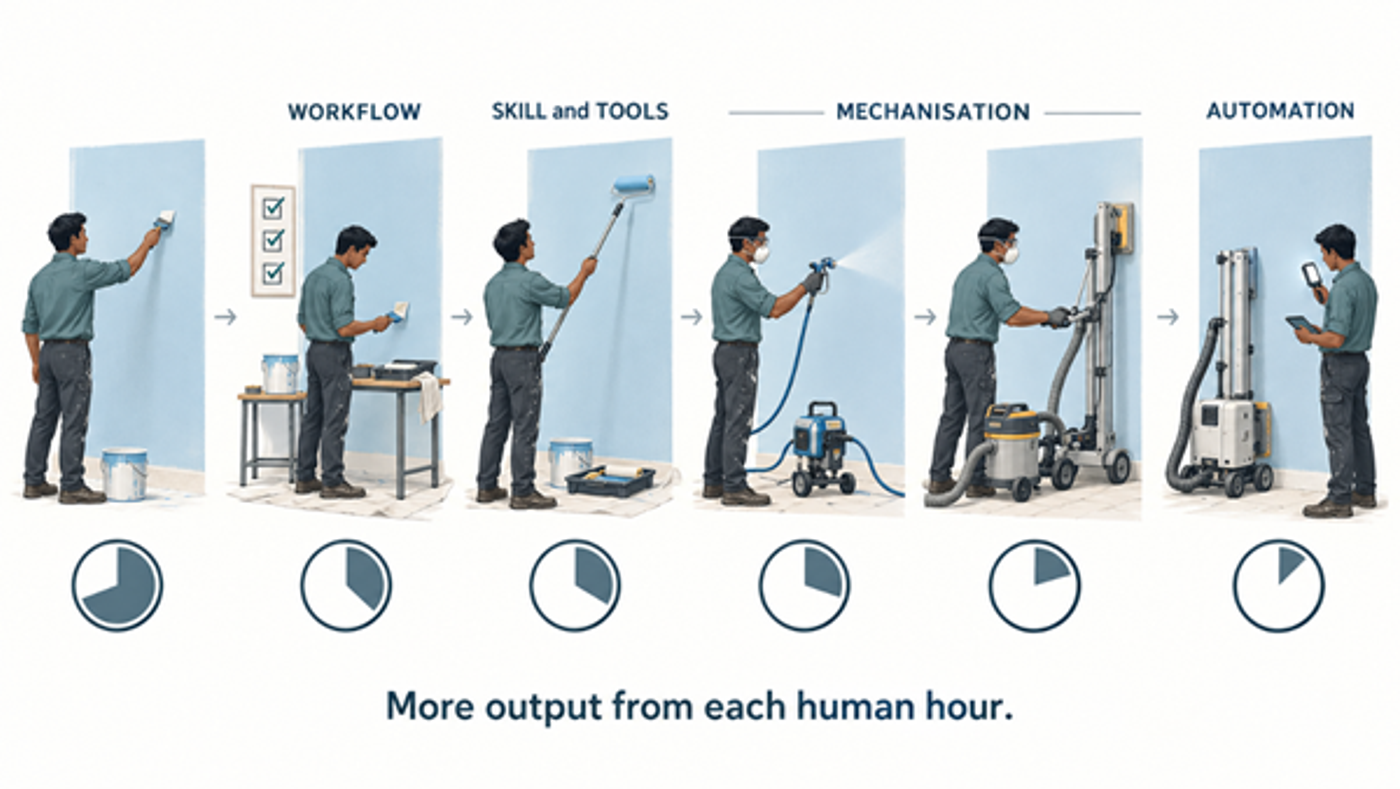
A modest example is dust control. NIOSH testing of vacuum-assisted drywall sanding systems found dramatic reductions in dust exposure compared with traditional sanding. The exact result should not be transplanted directly to Indian putty and site conditions, but the principle is important: a better tool can change the human experience of a task long before autonomous robots arrive.
Better access equipment, safer materials, suitable power tools and work organised to reduce unnecessary movement can do the same. Mechanisation should be judged partly by what it removes from a worker's day, not only by what it adds to output. Poorly designed mechanisation can create new risks, so equipment, training and work design have to evolve together.
At Zobocon, we are trying to move painting in this direction at our own small scale - through better tools, machine-assisted application and sanding, structured training, and work methods that reduce dependence on brute physical effort. The objective is not simply to make a painter work faster; it is to make the occupation progressively less punishing while increasing what skilled effort can produce.
Improved work design can also widen participation. Research on women in India's construction sector points to barriers such as sanitation, childcare, suitable protective equipment and limited career development. Labour scarcity is therefore partly a question of whom an occupation has made room for.
None of this guarantees that every worker displaced from a task will move smoothly into a better role. That transition requires learning opportunities, recognised skills and jobs that actually use them. Workers' knowledge should help shape new methods, and productivity gains should be visible in their working lives.
Painting still needs human judgement: assessing a surface, handling an exception, understanding a defect and accepting responsibility for the finish. The opportunity is to combine that judgement with a working life fewer people feel compelled to escape.
The question that remains
An industry cannot build a durable workforce strategy around the expectation that someone will always have sufficiently few alternatives to accept the old arrangement.
Which leaves an economic question that better recruitment alone cannot settle:
If fewer humans choose these occupations, how does an economy continue increasing physical output?
The companion article, 'When Labour Becomes Scarce, Productivity Stops Being Optional,' examines that question through production methods, investment and public policy.
Source notes
National Qualification Register (India): Assistant Construction Painter & Decorator occupational standards.
Population Council (2022): qualitative research on ethical recruitment and employment in India's construction industry, including Bengaluru and Delhi.
Bhatiya et al. (2026), European Economic Review: experiment on pay/location information and enrolment decisions among rural job seekers in Bihar.
BIBB (Germany): Painter and varnisher apprenticeship profile and master-craft progression.
UN DESA, World Population Prospects 2024: India's population projection.
ILO-Institute for Human Development, India Employment Report 2024: youth unemployment by education level.
OECD (2024), Understanding Labour Shortages: structural forces including job quality and skill mismatch.
NIOSH, Control of Drywall Sanding Dust Exposures: evidence on vacuum-assisted sanding controls.
ILO (2025), Creating opportunities for women in construction in India.