
Fewer Hands. More Work. What Has to Change?
Scarce labour does not have to mean stalled growth
The companion article asks why people should continue choosing difficult occupations if the work changes less than their alternatives. This article begins where that question leaves us: countries still need homes built, factories completed, goods moved and existing infrastructure maintained.
A smaller workforce does not automatically make those things impossible. But if available labour hours cannot keep expanding, sustained growth in physical output must increasingly come from producing more with each hour.
Productivity here is not a demand that workers simply work harder. It is an outcome of the production system: capital, skills, technology, organisation, workflow and human capability all contribute.
Labour scarcity can be managed in several ways. Greater participation, better matching, migration and shifts between activities can expand effective labour supply. Imports and different production methods can relieve some constraints. But when demand keeps growing and those adjustments cannot provide enough additional capacity, productivity becomes the durable lever.
Ageing economies make the pressure easier to see. The OECD projects a decline in its combined working-age population over coming decades and treats participation and productivity as complementary responses. Japan has gone further in construction, explicitly targeting large reductions in site labour requirements through automation, better data flows and changes in construction management.
India is on a different demographic timeline. Its immediate task is still to create better employment for a large workforce while increasing the capacity to deliver physical development. The point is not that India has run out of workers. The point is that labour-intensive growth becomes progressively harder if essential sectors cannot raise output per worker as occupational choices widen and demographic pressure eventually strengthens.
Productivity is a system, not a machine
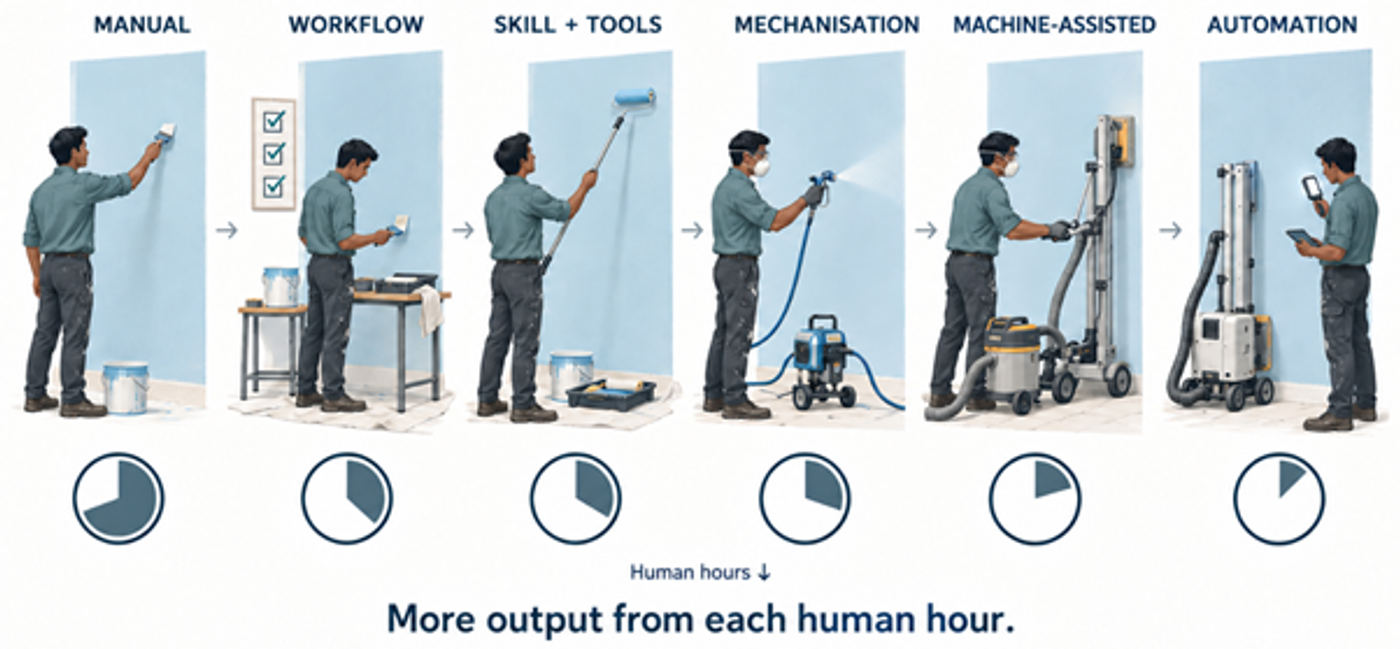
Painting makes the production question tangible. A wage increase can help recruit and retain a skilled painter. It cannot, by itself, complete the preceding trade, make an unfinished surface ready or remove time lost to repeated setup. If fewer painters are available for a growing volume of work, the production method has to improve alongside the employment offer.
The relevant outcome is completed work accepted at the required quality. A faster coat is not necessarily a faster finished flat. Preparation, movement, waiting, inspection and rework all enter the result. A machine that performs one operation quickly but creates more downstream correction may leave overall productivity unchanged.
The progression usually begins before sophisticated automation:
Better workflow -> training and specialisation -> better tools -> mechanisation -> machine-assisted execution -> automation -> selective robotics or autonomous execution.
This is not a compulsory ladder. Different tasks may stop at different stages, and skills and workflow must continue improving alongside equipment. A trained specialist with the right tool and a reliable sequence of ready work can be a better investment than automating an unstable process.
At Zobocon, this is roughly the path we are experimenting with in painting. Our working assumption is that productivity will not come from one machine or one piece of software, but from combining standard work, trained specialists, workfront readiness, better tools, measurement and progressively greater mechanisation. Automation becomes useful only after enough of the underlying execution system has been made repeatable.
There is strong evidence from outside construction that organisation itself matters. A randomised intervention in Indian textile plants found substantial productivity gains after better management practices were introduced. The precise gain should not be carried over to construction, but the lesson is important: better quality control, operating discipline and management can create meaningful productivity improvement before robotics enters the picture.
Research also links ageing to greater industrial automation where tasks are amenable to it. That qualification matters. A controlled factory line and a changing construction site are very different environments. Neither an ageing population nor the purchase of advanced equipment guarantees a productive autonomous system.
Why higher wages alone are not enough
Higher wages belong in this transition. They can improve retention, encourage training and strengthen the economics of equipment investment. But the arithmetic remains simple: labour cost per unit depends on compensation relative to accepted output. If wages rise while productivity does not, the labour component of unit cost rises.
Persistent constraints can then appear as higher bids, longer delivery times, declined work or reduced capacity. More expensive construction can make marginal projects less viable; unreliable completion can tie up capital and delay the use of an asset. Across enough labour-intensive sectors, such pressures can become a wider economic constraint.
Why companies may underinvest
Companies have every reason to improve productivity when they can capture the return. The harder policy question is what happens when the investment that would benefit the industry or economy is difficult for an individual firm to justify.
Consider a small contractor evaluating a new sanding or application system. Development involves trials, training, maintenance arrangements and disruption risk. The benefit may depend on having enough suitable projects over which to spread the cost. A method can make sense for the industry while remaining hard for that particular company to finance or defend against immediate margin and cash-flow pressures.
Some benefits also spill beyond the original investor. Methods spread. Equipment suppliers learn. Trained people carry knowledge between employers. Competitors imitate what works. Society may capture more of the long-run productivity benefit than the company that paid for the first round of experimentation.
That is not an accusation of corporate short-termism. It is a familiar economic coordination problem: private returns and social returns do not always line up neatly.
There is a second problem too: technology only works when the surrounding capabilities exist. Subsidising a machine without the skills, workflow, maintenance, measurement and management needed to use it can leave the central production problem untouched.
Where public policy can help
Government intervention therefore needs a more specific case than 'the industry is important' or 'technology is expensive'. The strongest case arises where there are real knowledge spillovers, shared testing needs, financing frictions or coordination failures - and where a practical intervention can address them without simply subsidising purchases that would have happened anyway.
International experience offers several models. Japan's i-Construction 2.0 treats construction labour saving as part of maintaining national infrastructure capacity. Singapore combines technology support with lean construction, job redesign, training, testing spaces and routes for pilots. Germany's Fraunhofer model shows how long-horizon technical capability can be supported while remaining connected to industry. South Korean experience with smart factories reinforces the complementarity between technology and management.
Italy provides an equally useful warning. Evaluation of its Transition 4.0 machinery incentives found that investment increased, but broad firm-level productivity gains were far less automatic. Buying more equipment and producing more efficiently are not the same outcome.
For India, the implication is not that one large automation subsidy should be created. It is that different bottlenecks need different instruments.
Where useful equipment already exists but financing is the constraint, limited mechanisation grants, concessional equipment finance, accelerated depreciation or shared rental models may help. Where the technology itself is uncertain, challenge grants, innovation prizes, shared R&D facilities and university-industry programmes may be more appropriate. Public demonstration sites can test whether a method survives real operating conditions. Training and certification support can build the complementary skills without which machinery remains underused.
Public procurement can also help by rewarding quality, safety, delivery and lifetime cost rather than prescribing one technology. The aim should be to create room for useful innovation while preserving competition.
When policy begins to see the trade
Some governments are beginning to move beyond treating construction productivity as one large problem and are identifying individual trades as targets for mechanisation and automation.
China’s 2025 Smart Construction Technical Guidelines explicitly identify wall-treatment and façade-spraying robots, including sanding, putty and paint application. Singapore’s Building and Construction Authority similarly treats painting and wall finishing as specific robotics and automation use cases.
India already recognises painting as a skilled trade and through technical specifications and workmanship standards. What is less visible is a comparable policy focus on painting execution itself as a productivity and automation domain.
That distinction matters: recognising the painter, the paint and the specification is not quite the same as recognising painting as a production process that can be systematically redesigned.
The real test: output, not equipment
India is not starting from zero. It already has a National Productivity Council, MSME lean initiatives, construction research capability within CSIR-CBRI and public housing technology demonstrations. Any new department, mission or dedicated corpus should therefore answer a practical question: what gap does it fill that existing institutions do not?
A credible productivity programme would publish outcomes, admit smaller firms, preserve competition, and revise or close interventions that do not work. It would measure accepted output per total labour hour alongside safety, worker outcomes, total cost, setup, maintenance and rework - not merely count machines purchased or certificates issued.
Governments already concern themselves with strategic productive capacity in energy, food, manufacturing and infrastructure. As demographics and occupational preferences change, the ability to execute essential physical work may deserve similar attention - not because every trade needs subsidy, but because an economy cannot assume that difficult labour will remain indefinitely abundant at yesterday's productivity.
The connection to the first article is direct. People gaining better choices is a legitimate human advance. Economies should prepare for essential work to compete harder for their time.
When adding more labour becomes difficult, growth increasingly depends on making each hour more productive - and making that progress practical enough to spread.
Source notes
OECD Employment Outlook 2025: projected decline in the OECD working-age population and policy responses involving participation and productivity.
World Bank (2022), Financing India's Urban Infrastructure Needs: infrastructure investment and delivery constraints.
NIST, Metrics and Tools for Measuring Construction Productivity: distinction between task, project and industry productivity.
Bloom et al. (2013), Does Management Matter? Evidence from India: randomised management intervention in textile plants.
Acemoglu and Restrepo (2022), Demographics and Automation, Review of Economic Studies.
OECD research on R&D incentives and the distinction between private returns and knowledge spillovers; World Bank, The Innovation Paradox, on complementary capabilities.
Japan MLIT, i-Construction 2.0: 2040 construction labour-saving and productivity targets.
Singapore Building and Construction Authority: Built Environment Technology and Capability grant and related testing/procurement initiatives.
Fraunhofer: institutional funding model for applied research connected to industry.
KDI: Smart Policies for Smart Factories, on technology and organisational complementarity.
Italy MEF/MIMIT/Banca d'Italia (2026): evaluation of Transition 4.0 investment incentives.
Official Indian institutions/programmes: National Productivity Council, MSME Lean Scheme, CSIR-CBRI construction automation/robotics, and MoHUA Global Housing Technology Challenge.