
Why Labour Shortages Will Reshape Construction
The emerging workforce challenge that may redefine productivity, reliability, and execution over the next decade.
For decades, construction has operated under a largely unquestioned assumption:
If a project needed more labour, more labour could eventually be found.
There may have been temporary shortages, seasonal disruptions, wage fluctuations, or regional constraints, but the broader belief remained intact. Labour was considered abundant. The industry's old challenge was often managing labour, not finding it.
That assumption deserves closer examination.
Across India and many other parts of the world, a growing body of evidence suggests that labour availability is gradually becoming a serious challenge rather than a temporary inconvenience. More importantly, the implications extend far beyond recruitment.
Labour scarcity is increasingly influencing productivity, quality, predictability, project schedules, and execution reliability.
In that sense, labour shortages may become one of the defining forces shaping the future of construction over the coming decade.
A Familiar Observation Across Projects
Speak to developers, contractors, EPC organizations, or project leaders across regions and a common observation often emerges.
Finding workers is somehow still possible. Finding the right workers, in sufficient numbers, has become more difficult.
The challenge is far more acute in finishing trades, specialized trades, supervisory roles, and projects operating under aggressive timelines.
What was once viewed as a periodic labour issue increasingly is now becoming a persistent operating reality.
The question is why.
Evidence From India’s Construction Workforce
The construction sector is one of India’s largest employers.
Various industry estimates place construction employment at roughly fifty million workers, making it one of the country’s largest sources of non-agricultural employment.
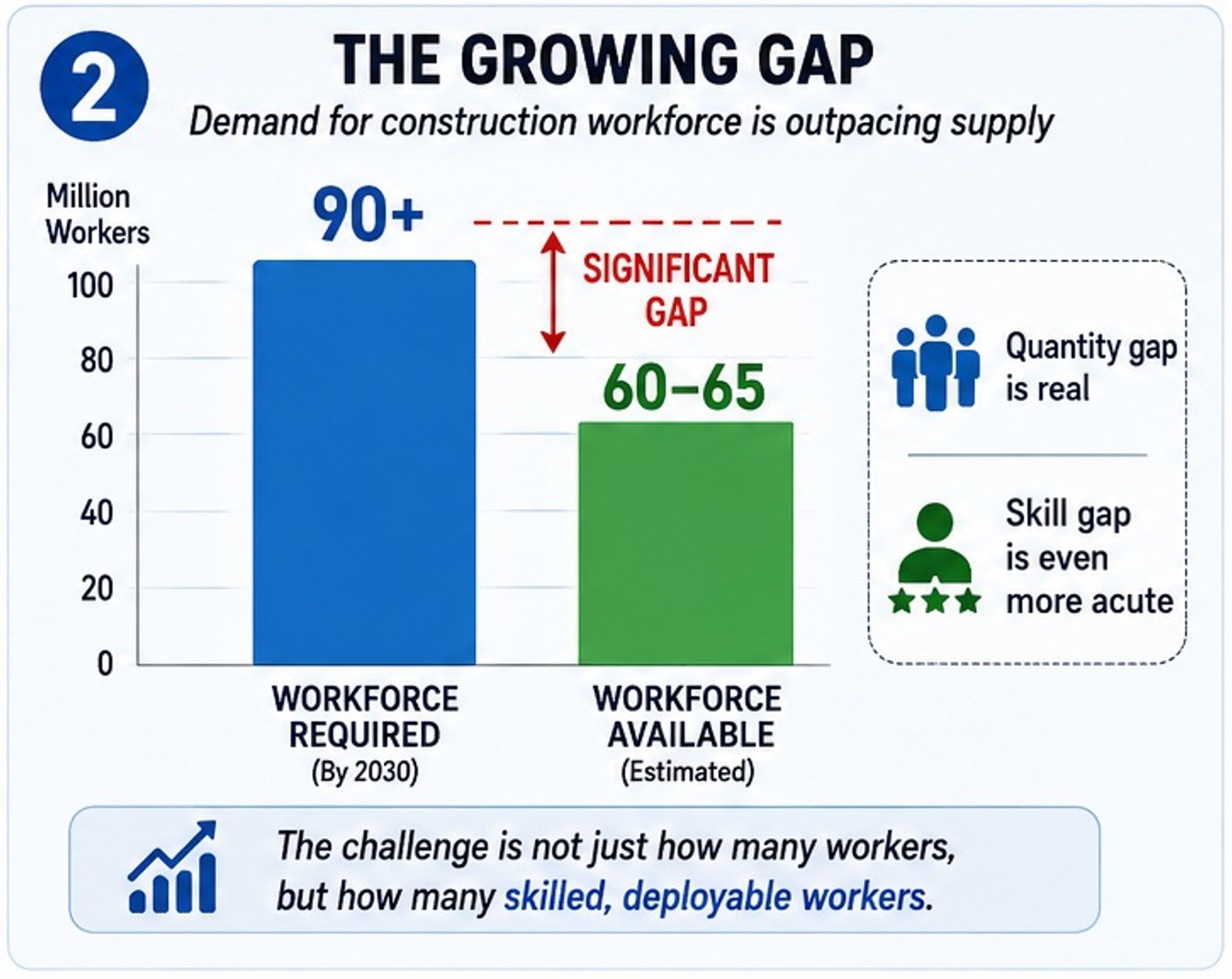
Yet workforce studies increasingly suggest that demand is growing faster than available supply. The Construction Skill Development Council of India estimates that the sector may require more than ninety million workers while available workforce capacity remains significantly lower.
More importantly, the shortage is most acute in skilled and semi-skilled categories.
This distinction matters.
A project can succeed if sufficiently skilled workers are available where the project is located, when they are needed, and for as long as they are needed.
This requirement is becoming increasingly difficult to satisfy.
The Skills Challenge Beneath The Labour Challenge
Perhaps the most significant workforce statistic in India is not related to construction at all.
It relates to skills.
Recent labour force surveys indicate that only a small percentage of India’s working-age population has received formal vocational or technical training.
Construction therefore relies heavily on workers who acquire skills through informal experience rather than structured training systems.
This model worked reasonably well when labour supply was abundant and projects could absorb variability.
However, as quality expectations rise, project timelines compress, and construction technologies evolve, the limitations become more visible.
The industry is not simply seeking workers.
It is increasingly seeking competent workers.
The difference matters.
A shortage of labour can still be solved through recruitment.
A shortage of skill requires years to solve.
Construction Is No Longer The Default Employer
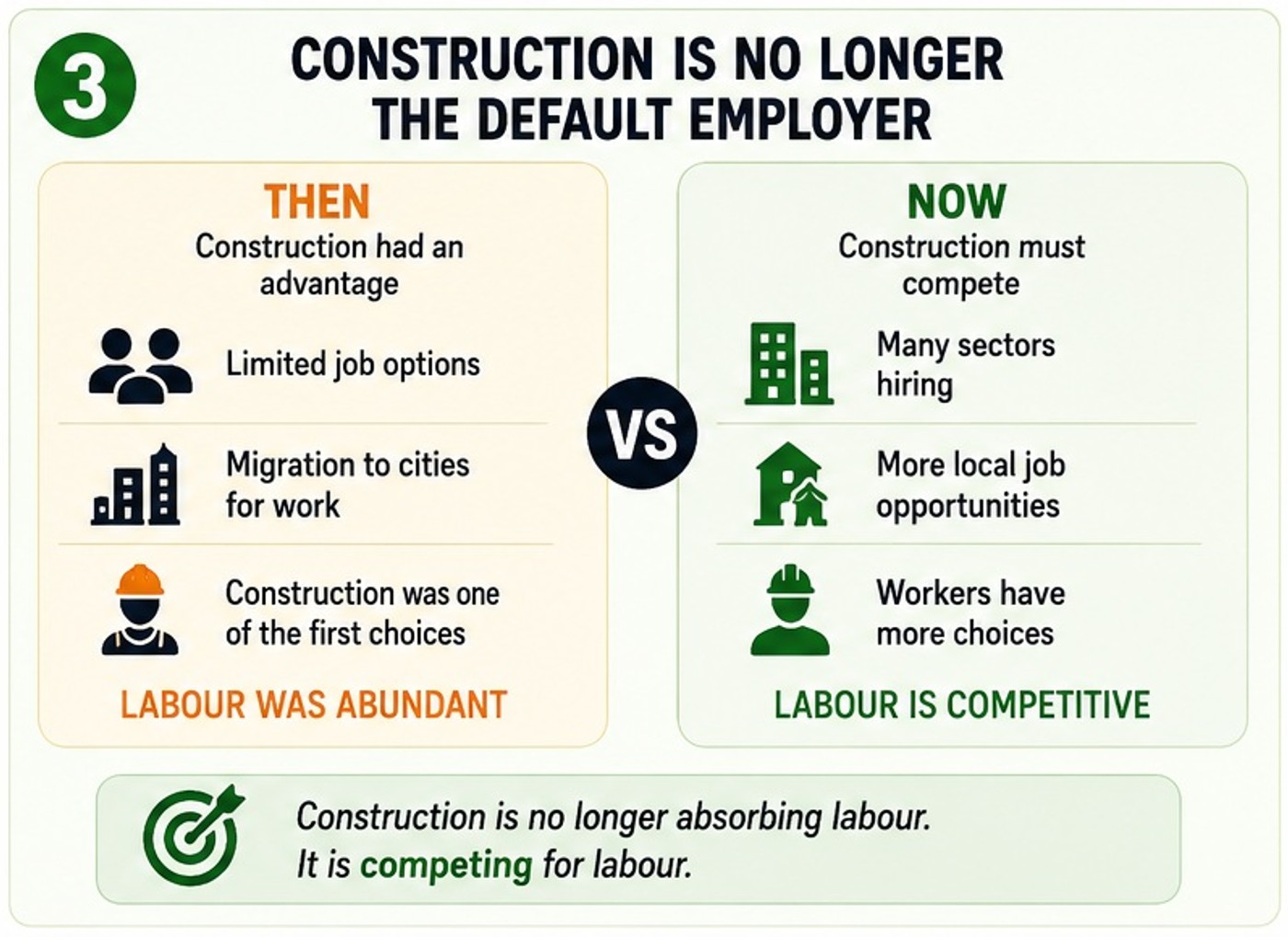
Historically, construction benefited from a powerful structural advantage.
For millions of workers leaving agriculture or rural economies, construction represented one of the most accessible sources of income. Large urban centres attracted labour from across the country, creating a steady flow of workers into construction projects.
That dynamic is gradually changing.
Economic activity is becoming more geographically distributed. Manufacturing investments are expanding. Logistics, warehousing, transportation, retail, e-commerce, and industrial services are creating alternative employment opportunities. Infrastructure spending is generating jobs across a wider range of regions than before.
As workers gain access to more choices, construction increasingly finds itself competing with other sectors for labour.
Many alternatives offer attributes that workers value:
Closer proximity to family
More predictable work schedules
Reduced migration requirements
Lower physical strain
Greater continuity of employment
The result is not necessarily a shortage of workers.
Rather, construction is losing its historical position as the default destination for available labour.
This represents a subtle but important shift.
For decades, construction primarily absorbed labour.
Increasingly, it must compete for labour.
Labour Scarcity Becomes A Reliability Problem
The consequence of labour scarcity may have little to do with labour itself.
Construction is fundamentally a coordination and dependency-driven industry. Every activity depends on another activity being completed before it can begin.
When labour availability becomes unpredictable, that coordination begins to break down.
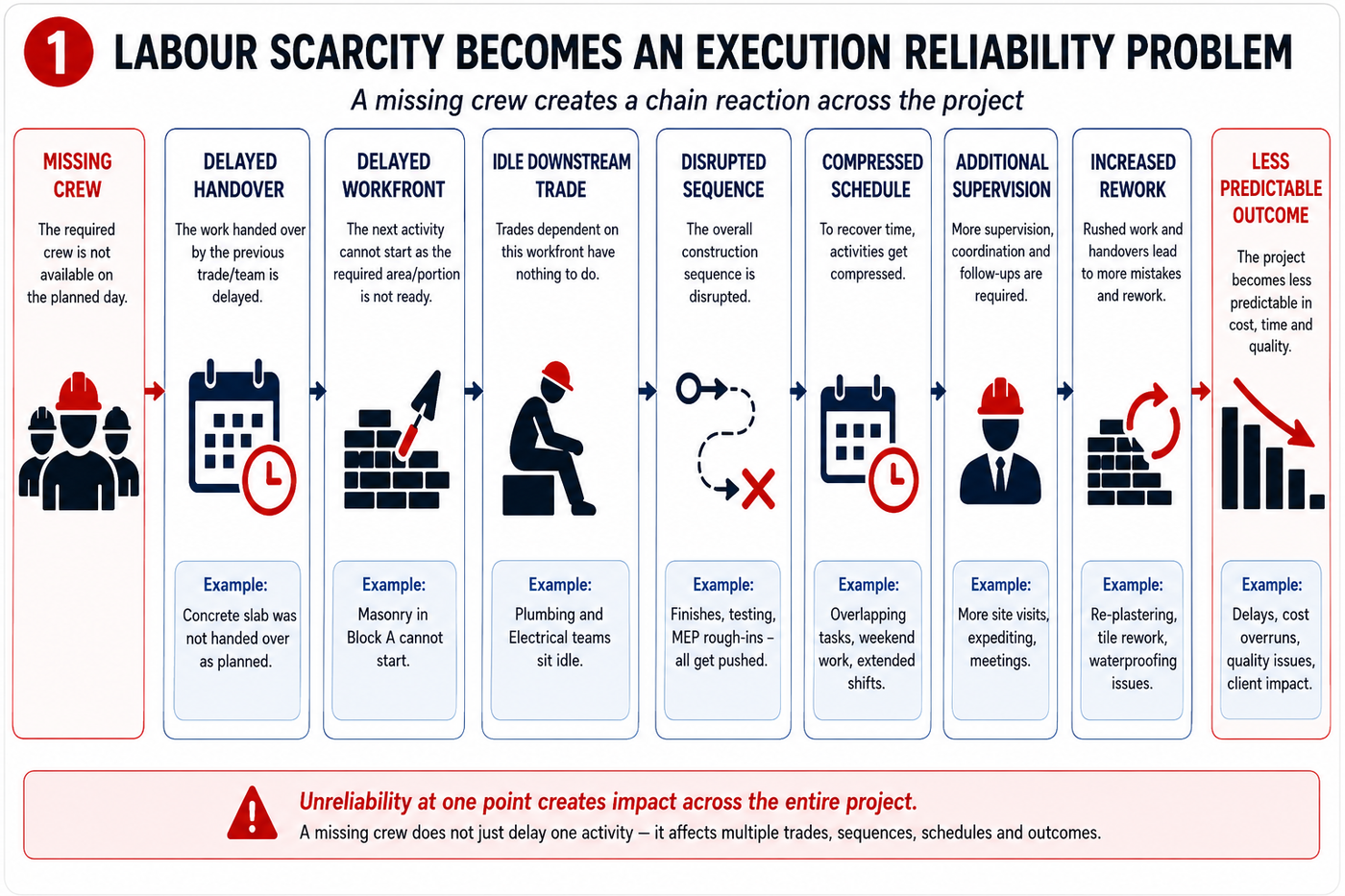
A delayed shuttering crew delays reinforcement work. Delayed reinforcement delays concrete. And eventually delays finishing trades. The impact rarely remains confined to a single activity.
What begins as a workforce issue gradually propagates through the project as schedule disruption, productivity loss, idle resources, rework, and cost escalation. And ultimately, a less predictable outcome.
This is why labour scarcity is often misunderstood. On top of that, labour scarcity in India appears counterintuitive. India remains one of the world’s most populous countries — how can labour shortages exist? And the immediate problem appears to be labour availability.
The actual problem is reduced execution reliability.
Construction does not operate as a collection of independent tasks. It operates as an interconnected system. As labour becomes less predictable, the entire execution system becomes less predictable.
For developers, contractors, and project leaders, this uncertainty is often more damaging than shortage.
Shortages can be planned for.
Uncertainty cannot.
As labour markets become more competitive, the industry’s central challenge may gradually shift from workforce availability to execution reliability.
Labour Scarcity Is Becoming A Strategic Constraint
For much of its history, construction has treated labour primarily as an operational challenge.
Projects required workers. Contractors mobilized workers. Execution teams managed workers.
Labour availability was important, but it rarely shaped broader strategic decisions.
That may be beginning to change.
As construction demand continues to grow and labour markets become increasingly competitive, workforce availability is starting to influence questions that extend far beyond manpower planning.
How quickly can a project scale?
How reliably can schedules be maintained?
How much execution capacity can an organization build?
How many projects can it undertake simultaneously?
How rapidly can it expand into new geographies?
These are no longer purely operational questions. They are increasingly linked to workforce capability.
This shift is significant because construction remains one of the most labour-dependent industries in the economy. Unlike many sectors where production capacity can be expanded primarily through equipment or facilities, construction capacity remains closely tied to the availability of people.
As labour becomes more difficult to attract, retain, and deploy consistently, workforce constraints begin influencing growth itself.
For developers, it can affect project delivery capacity.
For contractors, it can affect execution capacity.
For EPC organizations, it can affect expansion plans.
For policymakers, it can affect the speed at which infrastructure ambitions can be translated into completed projects.
In this sense, labour scarcity is gradually moving beyond workforce planning.
It is becoming a strategic constraint on execution capacity.
The industry has not fully adapted to this reality yet. Many construction activities continue to rely on execution models developed during a period when labour was assumed to be abundant and readily scalable.
Whether those assumptions remain valid over the next decade remains an open question.
The Industry Has Not Fully Adapted Yet
Labour scarcity is widely discussed across construction.
The industry’s response, however, remains uneven.
Certain segments of construction have undergone significant industrialization over the past two decades. Structural systems such as advanced formwork technologies, ready-mix concrete, mechanized equipment, precast elements, and modular approaches have steadily reduced dependence on manual labour.
Many finishing and non-structural activities have evolved more slowly.
Painting, plastering, masonry, tiling, waterproofing, and several finishing trades continue to depend heavily on skilled labour availability.
As a result, a growing gap may be emerging between the industry’s future workforce realities and many of its current execution models.
How construction responds to that gap remains an open question.
The Decade Ahead
Human labour will remain central to construction for the foreseeable future.
Buildings, infrastructure, industrial facilities, and urban environments will continue to require skilled human effort.
The future is unlikely to be labour-free.
Yet the assumptions that shaped construction over the past several decades are changing fast.
Labour markets are becoming more competitive.
Skill requirements are increasing.
Workforce expectations are evolving.
Execution demands continue to rise.
These forces suggest that labour availability may become a more important strategic consideration than it has been historically.
How significant that shift becomes will vary across regions, project types, and trades.
What appears increasingly clear, however, is that labour scarcity is unlikely to remain merely a workforce discussion.
It is becoming an industry discussion.
Conclusion
Construction is not simply facing a shortage of workers.
It is increasingly facing a shortage of skilled, reliable, and deployable workers relative to the scale of future demand.
That distinction matters because it changes the nature of the challenge.
What appears on the surface as a labour issue increasingly influences productivity, quality, schedules, and execution reliability.
In that sense, labour scarcity should not be looked at as only a workforce challenge, but as one of the defining forces reshaping construction execution over the coming decade.