
Construction's Next Frontier Is Execution
Construction has improved dramatically over the past several decades. Designs are better. Materials are better. Machinery is better. Software is better. Project management is better. Yet project delivery continues to vary significantly from one project to another. Why?
An Industry Of Extraordinary Achievement
Few industries shape economies, cities, and daily life as profoundly as construction.
The buildings we live in, the roads we travel on, the factories that produce goods, the airports that connect nations, and the infrastructure that supports modern society all originate from construction.
Over the past several decades, the industry has made remarkable progress.
- Structural engineering has enabled taller and more complex structures.
- Materials have become stronger, lighter, and more specialized.
- Digital design tools have transformed planning and coordination.
- Building Information Modeling (BIM) has improved visibility across disciplines.
- Safety systems have advanced.
- Project management methodologies have matured.
- Machinery and equipment continue to increase physical capability.
Today's projects are larger, more sophisticated, and more technically demanding than those delivered a generation ago.
In many respects, construction is far more capable / smarter today compared to anytime in the history.
Yet an important question remains.
If the industry has improved so dramatically, why do project deliveries continue to vary so widely?
The Construction Paradox
Construction has better tools than ever before.
- Yet delays remain common.
- Rework remains common.
- Productivity varies significantly between projects.
- Quality outcomes vary significantly between teams.
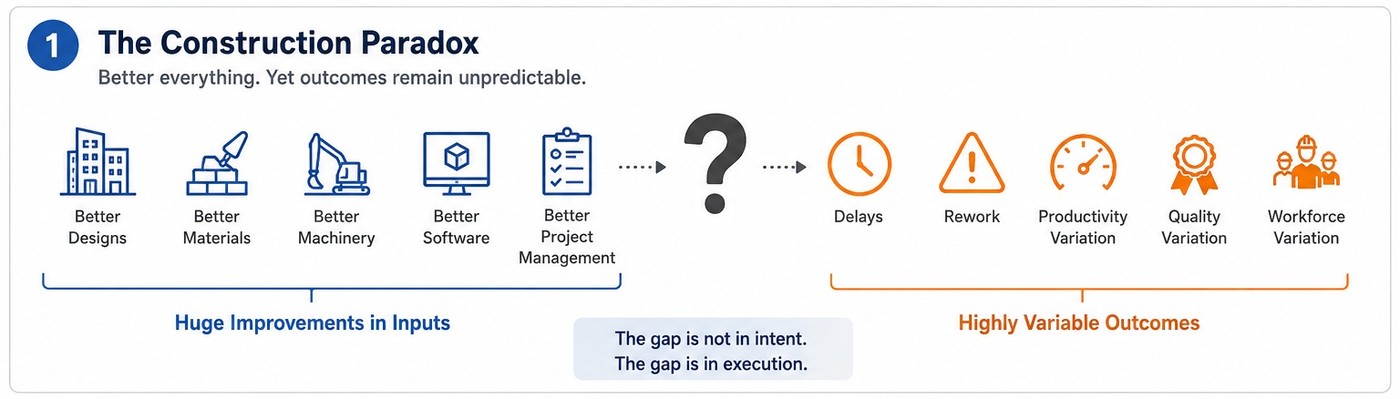
Two projects can begin with nearly identical drawings, specifications, materials, technologies, and budgets. Yet one project progresses smoothly while another struggles with schedule slippages, productivity losses, and quality issues.
This creates an interesting paradox.
How can an industry improve so much and still produce such variable results?
The answer may not lie in what construction is building.
It may lie in how construction is executed.
The Real Challenge Is Variability
Many discussions about industry performance focus on productivity.
Productivity is important.
But productivity is often a symptom rather than the underlying issue.
The deeper challenge is variability.
Why does one crew consistently outperform another?
Why does one project require extensive rework while another does not?
Why does one site achieve predictable progress while another experiences continual disruption?
Why can the same activity produce dramatically different outcomes under seemingly similar conditions? Variability appears in many forms:
- Quality variation
- Productivity variation
- Schedule variation
- Rework variation
- Workforce variation
Every of the above variation introduces uncertainty.
And uncertainty eventually appears as delays, defects, cost overruns, and lost productivity.
The pursuit of productivity may therefore be less important than the pursuit of reliability.
Reliable systems often become productive systems. The reverse is not always true.
The Human Variability Challenge
Construction remains one of the most human-dependent industries in the world.
Every day, thousands of decisions are made on active job sites.
Activities must be sequenced correctly. Trades must be coordinated. Quality must be maintained. Problems must be solved in real time.
Much of this depends on people:
- The knowledge of supervisors.
- The skills of workers.
- The effectiveness of communication.
- The consistency of execution.
- The availability of experienced labour.
As a result, as suggested earlier, two teams performing the same activity can produce noticeably different outcomes.
This is not necessarily a reflection of effort. Nor is it a reflection of intent. More often, it reflects the systems within which people operate.
Human capability matters. But “system capability” matters as well.
And unlike many industries, construction has historically depended more heavily on individual capability than system capability.
The Missing Layer
Historically, much of the industry's innovation has focused on three fundamental questions.
- What should we build? Architecture, engineering, and design.
- What should we build it with? Materials, equipment, and technology.
- How should we manage the project? Planning, scheduling, procurement, contracts, and finance.
All have created enormous value.
Yet another question has often received less attention.
How should work be repeatedly executed?
Not planned. Not designed. Not managed.
But Executed — Day after day; Floor after floor; Building after building.
This layer sits between planning and physical delivery.
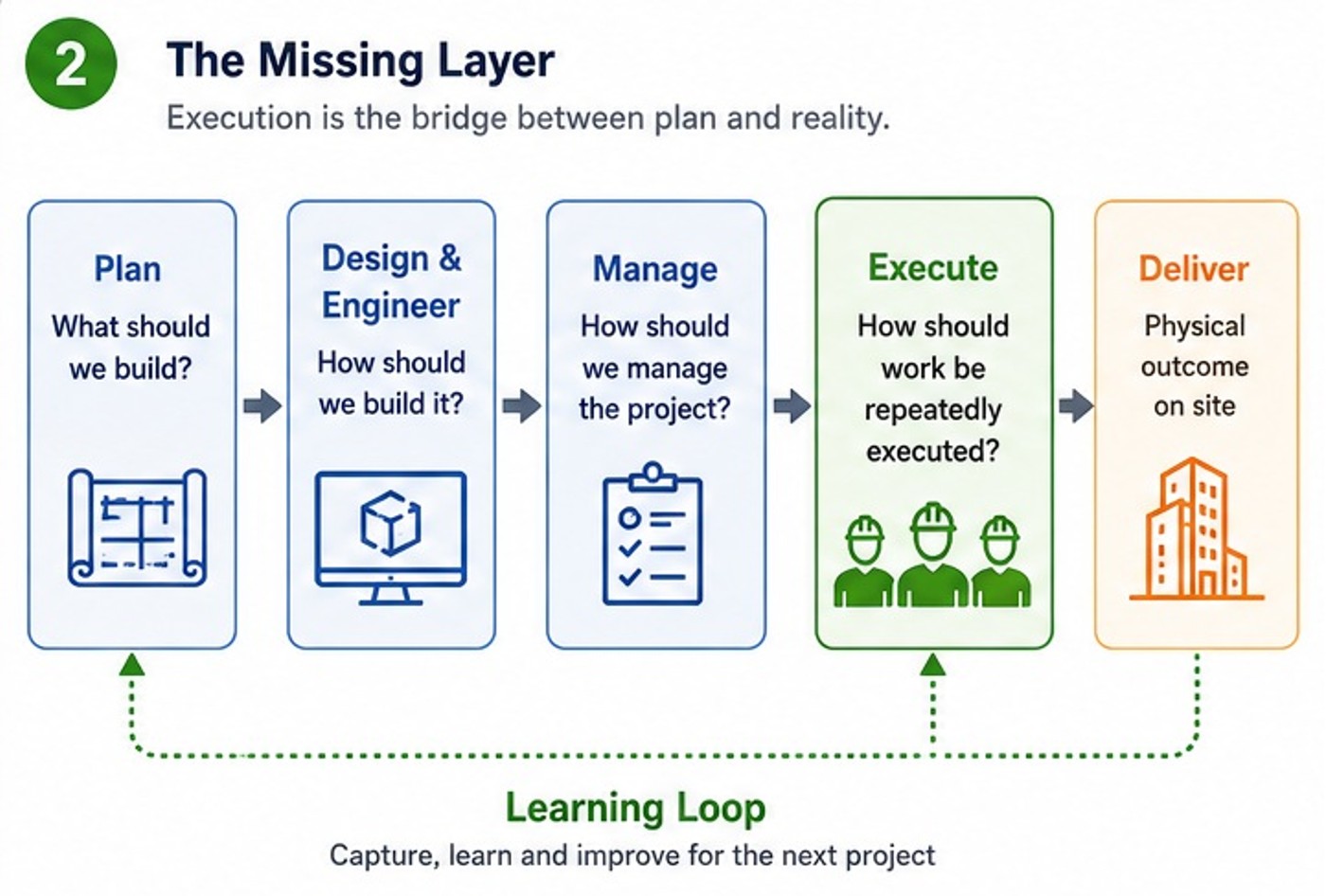
It is where drawings become reality. It is where specifications become workmanship. It is where variability enters the system.
And it is often where project outcomes are ultimately determined.
Lessons From Manufacturing
When people think about manufacturing excellence, they often think about automation and robots.
But many of manufacturing's most significant gains occurred before widespread automation.
The deeper transformation was the development of execution systems.
Early factories often depended heavily on individual worker skill and judgment. Output varied. Quality varied. Productivity varied.
As manufacturing matured, attention shifted. Processes became standardized. Workflows became engineered. Measurements became routine. Feedback loops became systematic.
Variability became a problem to be actively reduced rather than simply tolerated.
The objective was not to eliminate human skill. The objective was to make outcomes less dependent on individual variability.
The same people, operating within better systems, began producing significantly more predictable results.
Perhaps manufacturing's greatest breakthrough was not automation.
Perhaps it was the realization that execution itself could be engineered.
Beyond Manufacturing
Manufacturing is not the only industry that followed this path.
Modern aviation assumes that highly trained professionals can still make mistakes. Therefore aviation relies on procedures, checklists, cross-checks, certifications, traceability, and continuous learning systems.
Healthcare increasingly relies on protocols and surgical checklists to improve consistency and reduce error.
Global logistics networks move millions of packages every day through highly structured operating systems.
Fast-food chains such as McDonald's do not depend on finding extraordinary workers for every location. They depend on creating systems that enable ordinary teams to consistently deliver predictable outcomes.
The common theme is not technology. The common theme is reliability.
Each industry learned that long-term performance depends less on individual heroics and more on the quality of the system itself.
Why Execution Is Becoming More Important
Historically, many execution inefficiencies could be absorbed.
Projects were smaller. Labour was more readily available. Schedules were often more forgiving.
Today, those conditions are changing.
Projects are becoming larger and more complex. Quality expectations continue to rise. Customers increasingly expect predictable delivery. Margins remain under pressure. Skilled labour is becoming more difficult to find in many markets.
The challenge is no longer simply finding workers. It is finding experienced workers consistently.
As labour becomes scarcer, execution systems become more important.
The objective shifts from depending on exceptional individuals toward creating systems that enable ordinary teams to perform consistently at a higher level.
Given all the above, execution is no more an operational concern, but a strategic one.
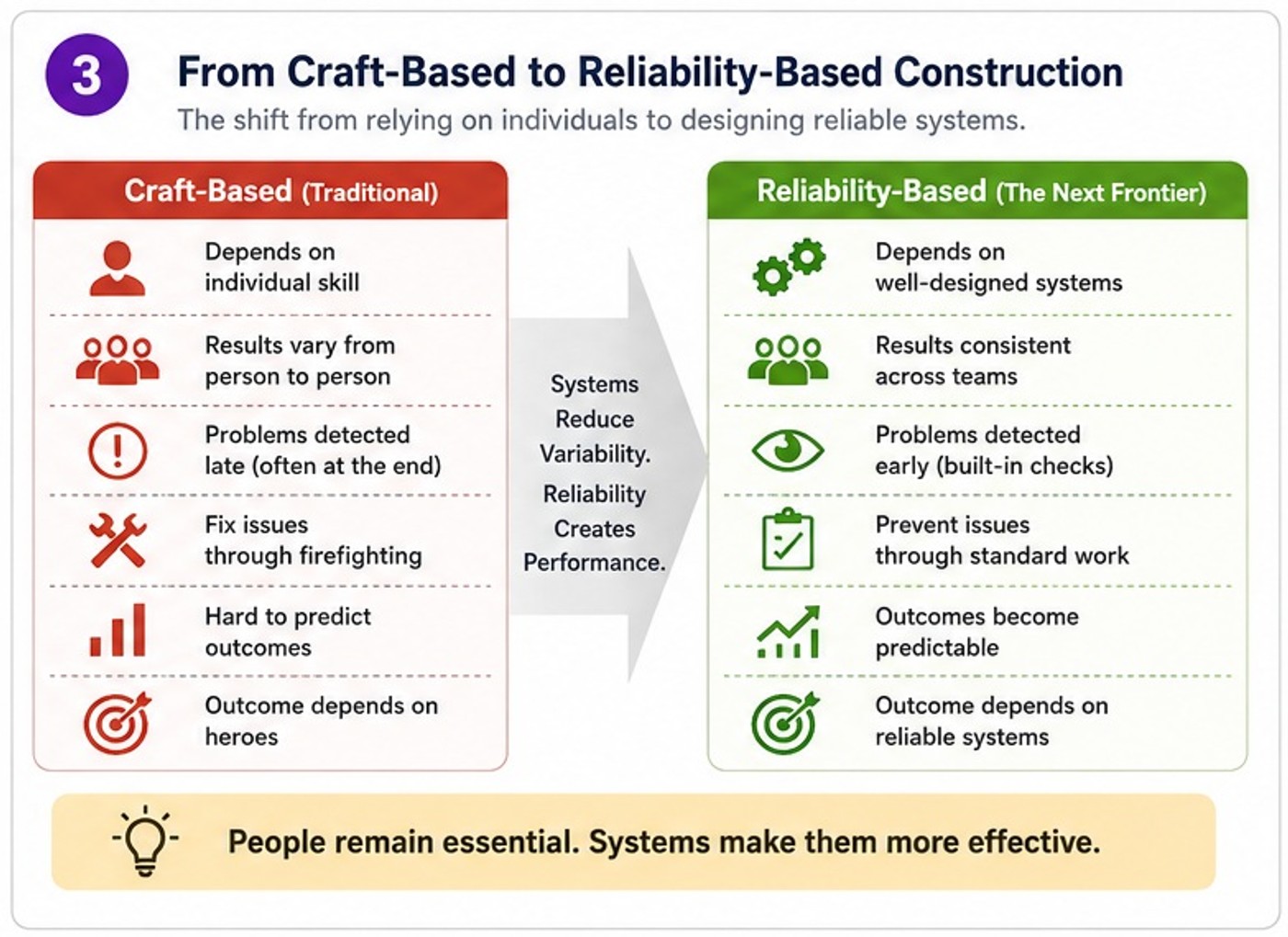
From Craft-Based Production To Reliability-Based Production
Construction has historically been built upon craftsmanship.
Craftsmanship remains essential. It always will.
But many industries eventually discover that skill alone cannot deliver reliability at scale.
The challenge becomes creating systems that continue to perform well despite inevitable human variability.
- People become unavailable.
- People become tired.
- People make mistakes.
- People differ in skill.
The question is not whether variability exists. The question is how effectively a system manages it.
This represents an important shift in thinking.
The future may not belong to organizations with the most talented individuals.
It may belong to organizations that build the most reliable execution systems.
The Emergence Of Execution Engineering
As projects become larger and execution challenges become more complex, attention is gradually moving closer to the point where work is actually performed.
The industry is increasingly asking questions such as:
- How should work be sequenced?
- How should productivity be measured?
- How can quality be made more predictable?
- How can lessons learned on one project be transferred to the next?
- How can variability be systematically reduced?
- How can reliability be improved?
These questions extend beyond traditional project management. They focus on the design of the execution system itself.
Viewed through this lens, execution becomes more than a collection of site activities.
It becomes a system that can be designed, measured, improved, replicated, and continuously refined.
This emerging perspective may eventually evolve into a more formal discipline focused on execution performance.
A discipline concerned not only with managing projects, but with engineering how projects are delivered.
The Next Frontier
Every major phase of construction's evolution has been driven by a different breakthrough.
Engineering enabled larger and safer structures. Materials expanded what could be built. Machinery increased physical capability. Project management improved coordination. Digital technologies enhanced visibility and planning.
The next breakthrough may come from a different direction.
Not from deciding what to build. Not from deciding what to build with. But from systematically improving how work is executed.
For decades, execution was often viewed as the final step of construction.
It may now be becoming the central challenge.
And if that is true, then the next major frontier for construction improvement is not design, finance, or materials.
It is execution.