Construction Is Scaling Faster Than Its Management Systems
The Industry's Next Challenge May Not Be Building Bigger Projects—But Coordinating Them Reliably
Construction has always been a complex industry.
Every project involves multiple stakeholders, changing site conditions, workforce variability, material dependencies, safety requirements, quality standards, and schedule pressures.
Complexity is not new. The pace at which that complexity is increasing, is.
Across the world, construction projects are becoming larger, faster, and more interconnected than ever before.
Mega infrastructure programs are expanding.
High-rise projects continue to increase in scale.
Quality expectations are rising.
Project schedules are becoming more compressed.
At the same time, labour availability is becoming scarce and less predictable, regulatory requirements are increasing, and stakeholder expectations continue to grow.
The question is whether the systems used to coordinate and execute these projects are evolving at the same pace.
Because while construction itself has changed dramatically, many execution and management practices on site have evolved far more slowly.
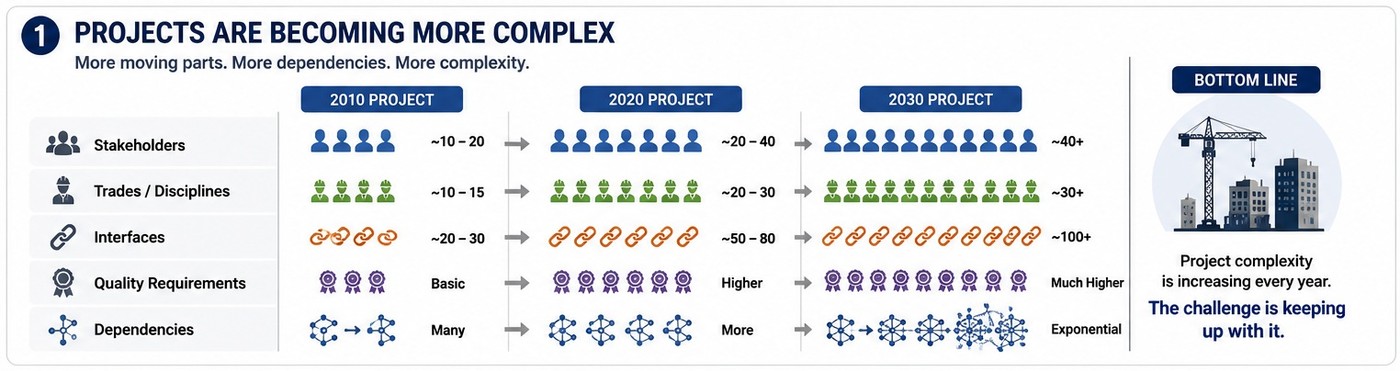
Modern Projects Have Far More Moving Parts
A modern construction project is no longer simply a collection of activities happening on the same site.
It is a large network of interconnected tasks, teams, and dependencies.
Design decisions affect procurement.
Procurement affects site readiness.
Site readiness affects trade productivity.
Execution productivity affects downstream activities.
Quality issues create rework.
Rework affects schedules.
Schedules affect workforce deployment.
Workforce disruptions affect every activity that follows.
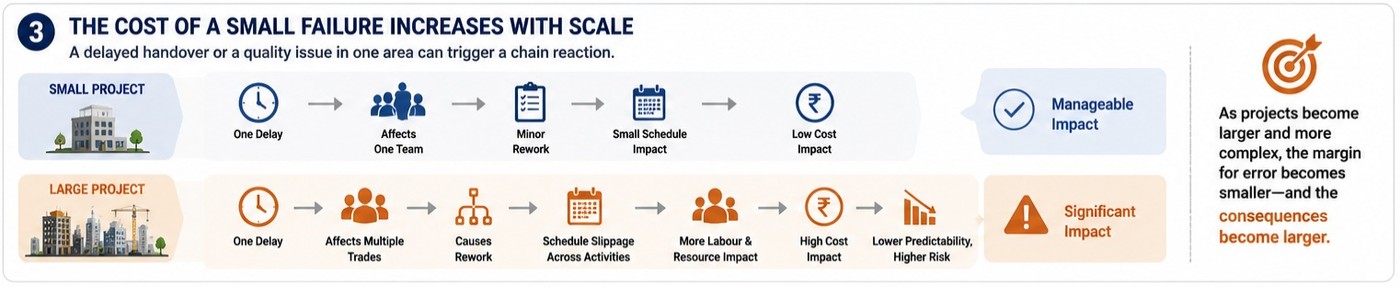
A delay in one area often creates consequences elsewhere.
A problem that appears small can quickly affect multiple teams.
Consider a large residential or mixed-use development.
Hundreds of workers may be active on site.
Dozens of subcontractors may be involved.
Thousands of inspections may be required.
Tens of thousands of individual tasks must be completed in the right sequence.
The challenge is no longer simply performing individual activities well.
The challenge is keeping all those activities aligned.
Yet Many Site-Level Practices Remain Largely Unchanged
Despite increasing project complexity, much of site execution still depends heavily on:
Manual coordination
Verbal communication
Individual experience
Supervisor judgement
Informal planning
Reactive problem solving
Even then many projects succeed precisely because experienced engineers, supervisors, contractors, and project managers continuously solve problems in real time.
Construction professionals often manage extraordinary complexity under difficult conditions.
The industry's challenge is not a shortage of effort.
The challenge may be that projects are becoming more complex faster than traditional coordination approaches can comfortably scale.
As projects become larger, even highly capable people face limits.
There are only so many activities one person can track.
Only so many decisions that can be made in a day.
Only so many dependencies that can be managed manually.
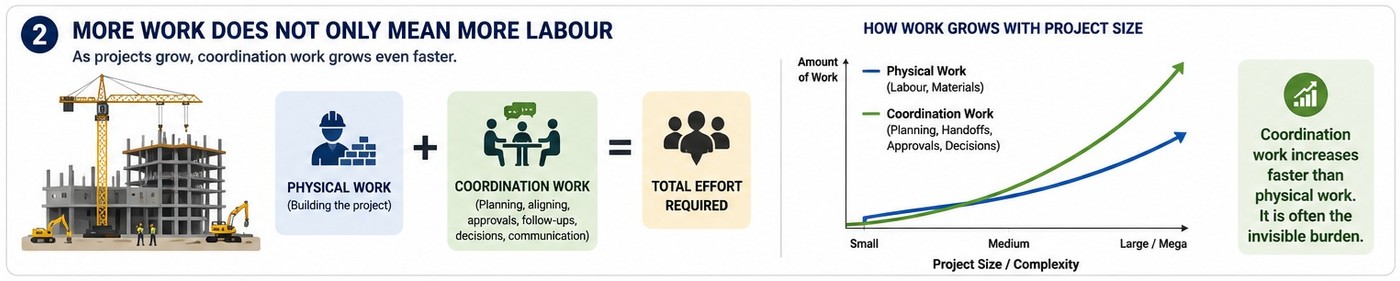
Bigger Projects Create More Coordination Work
When people think about construction work, they usually think about physical execution.
Concrete placement.
Steel erection.
Mechanical installation.
Painting.
Finishing activities.
But as projects grow, another type of work grows even faster.
Coordination.
More meetings.
More inspections.
More approvals.
More follow-ups.
More communication between teams.
More decisions that must be made at the right time.
A larger project does not simply require more labour.
It requires significantly more coordination.
More handoffs between trades.
More interfaces between teams.
More schedule dependencies.
More opportunities for things to go wrong.
In many cases, the challenge is not whether teams know how to perform the work.
The challenge is whether the project can consistently coordinate the work.
Working Harder Has Limits
Historically, many construction challenges have been overcome through experience, dedication, and extraordinary effort.
When schedules slipped, teams worked longer hours.
When labour shortages appeared, supervisors adapted.
When coordination problems emerged, project teams found practical solutions.
This adaptability has always been one of construction's strengths.
But increasing complexity raises an important question.
Can projects continue scaling indefinitely by relying primarily on people working harder?
Or does there come a point where growing complexity requires stronger systems to support the people delivering the work?
Many industries have faced similar questions.
As aviation became more complex, checklists became essential.
As healthcare systems expanded, standardized operating procedures became increasingly important.
As logistics networks grew, coordination systems evolved alongside physical infrastructure.
The objective was not to replace expertise. The objective was to help expertise operate reliably at scale.
Construction may be approaching a similar moment.
Reliability Is Becoming More Valuable
Historically, construction competition has often focused on cost, technical capability, and execution capacity.
Those factors remain important.
But another capability is becoming increasingly valuable.
Reliability.
Can work begin when planned?
Can labour be mobilized predictably?
Can quality remain consistent?
Can dependencies be managed systematically?
Can execution remain stable despite increasing complexity?
These questions increasingly influence project outcomes.
They affect productivity.
They affect quality.
They affect schedules.
They affect profitability.
Most importantly, they affect confidence.
As projects become larger, the cost of disruption becomes larger too.
A minor coordination issue on a small project may be manageable.
The same issue on a large project can affect hundreds of workers, multiple subcontractors, and several downstream activities.
As scale increases, reliability becomes more important.
The Industry May Need More Than Better Management
The instinctive response to increasing complexity is often to ask managers, engineers, and supervisors to do more.
More monitoring.
More reporting.
More meetings.
More coordination.
More oversight.
Yet there may be a limit to how much complexity can be absorbed through management effort alone.
As projects become more complex, asking people to work harder may not be enough.
They may need better systems to support them.
Systems that improve visibility.
Systems that improve coordination.
Systems that improve workforce readiness.
Systems that improve measurement.
Systems that improve quality consistency.
Systems that create feedback loops between planning and execution.
Not because people are failing.
But because the environment they are operating in is becoming more demanding.
The challenge may not be the capability of construction professionals.
The challenge may be whether the systems supporting them are keeping pace with the complexity of the projects they are expected to deliver.
Looking Ahead
Construction has demonstrated an extraordinary ability to build larger projects, taller buildings, more ambitious infrastructure, and increasingly sophisticated developments.
The industry's future challenge may not be what it can build.
The future challenge may be how reliably it can execute what it already knows how to build.
As project complexity continues to increase, the discussion may gradually shift:
From solving problems after they occur to preventing problems before they occur.
From depending primarily on individual effort to supporting that effort with stronger systems.
From managing increasing complexity manually to building better ways of coordinating it.
If construction continues to scale, an important question emerges:
Are the execution systems supporting the industry evolving as quickly as the projects themselves?
The answer may shape the next phase of construction's evolution.