
Betting On Capabilities: What Construction Can Learn From Toyota
As construction scales in size and complexity, the industry's next challenge may not be what to build—but how to execute it reliably at scale.
In the decades following the Second World War, Toyota was a relatively small automotive manufacturer competing against significantly larger global players.
At the time, few would have predicted that Toyota would eventually become one of the most influential industrial companies in the world.
The remarkable part of Toyota's story is not that it built cars.
Many companies built cars.
The remarkable part is that it built a capability.
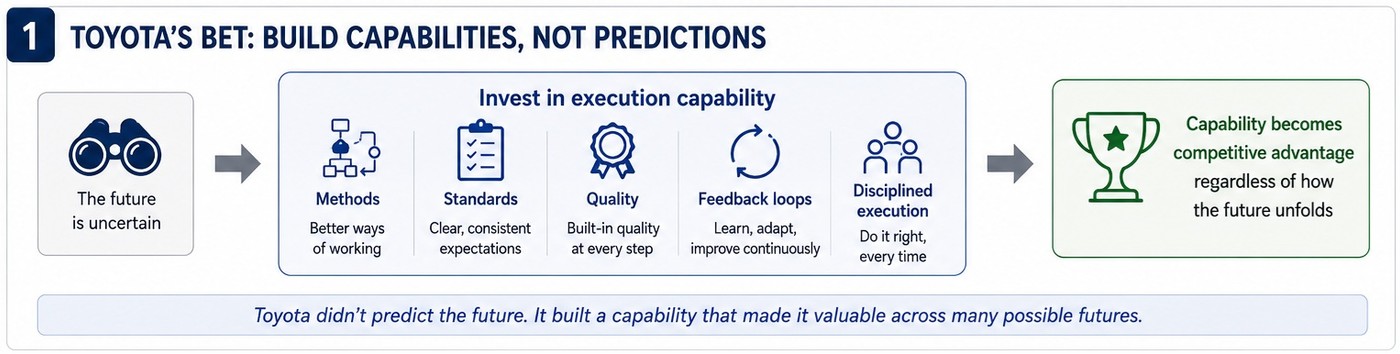
Toyota invested for decades in developing what later became known as the Toyota Production System.
It created methods, workflows, standards, quality controls, feedback loops, and operating disciplines designed to produce reliable outcomes at scale.
The company did not know exactly how the automotive industry would evolve over the following decades.
It simply believed that superior execution capability would become increasingly valuable.
History proved that belief correct.
Today, the Toyota Production System is studied far beyond the automotive industry.
Its influence can be seen across manufacturing, logistics, healthcare, technology, and operations management.
Construction may be approaching a similar moment.
Not because construction should become manufacturing.
Not because every activity can be standardized.
But because the industry's scale, complexity, and coordination requirements are increasing faster than its execution capabilities.
Construction Is Growing Faster Than Its Execution Systems
The long-term demand drivers for construction are well understood.
Cities continue to expand.
Infrastructure continues to grow.
Housing demand continues to rise.
Industrial and commercial development continues to evolve.
Few industries have greater long-term relevance to economic development.
Yet despite decades of advances in materials, equipment, engineering design, and construction technology, many projects continue to experience familiar challenges:
Delays
Rework
Productivity variability
Labour shortages
Quality inconsistencies
Coordination failures
The industry's ability to engineer structures has advanced dramatically.
Its ability to engineer execution remains a comparatively newer frontier.
As projects become larger and more interconnected, this gap becomes increasingly visible.
Most Industries Eventually Reach A Systems Threshold
As industries scale, complexity eventually exceeds what can be managed through supervision, experience, and individual effort alone.
At that point, systems emerge.
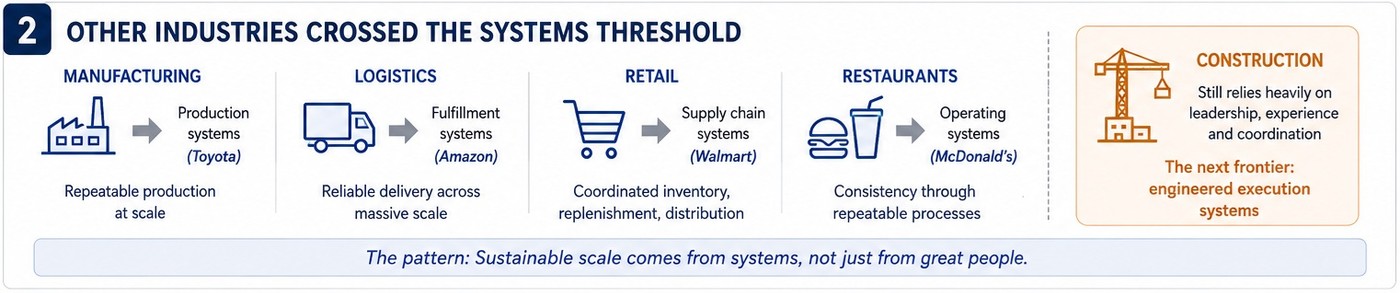
Manufacturing experienced this transition through production systems, exemplified by Toyota's production system.
Logistics experienced it through fulfillment systems. Companies such as Amazon built sophisticated execution engines capable of delivering consistent outcomes across enormous scale.
Retail experienced it through supply chain systems, where organizations like Walmart gained advantage not merely through stores, but through superior coordination of inventory, replenishment, and distribution.
Restaurants experienced it through operating systems that transformed cooking from a craft into a repeatable process. The global consistency achieved by McDonald's is as much a triumph of execution systems as it is of food preparation.
The common pattern was not technology alone.
The common pattern was engineered execution.
Organizations discovered that sustainable scale is achieved not through working harder, but through building systems that make performance repeatable.
The winners were often not those with the best individual operators.
They were those with the most reliable operating systems.
Construction Has Historically Scaled Through Leadership And Coordination
Construction remains unusual in this regard.
Many industries eventually embedded their operating knowledge into systems, processes, and standardized execution models.
Construction, however, has historically relied on a different approach.
Project outcomes continue to be heavily influenced by:
Leadership capability
Contractor capability
Coordination effectiveness
Experience-based decision making
Active management intervention
This model has delivered remarkable results over many decades.
Some of the world's most complex buildings, infrastructure projects, and urban developments have been delivered through the expertise and commitment of project teams operating under these conditions.
The challenge is not that this approach is ineffective.
The challenge is that projects are becoming larger, more interconnected, and more complex.
Schedules are tightening.
Labour availability is becoming less predictable.
Quality expectations continue to rise.
As a result, the amount of coordination required to maintain reliable outcomes is increasing significantly.
The question is whether traditional management approaches can continue absorbing this growing complexity indefinitely, or whether construction will increasingly require execution systems that scale alongside project ambition.
The Industry Is Already Responding
Signs of adaptation are already appearing across the industry.
Developers are investing in digital systems.
Contractors are adopting mechanization.
Manufacturers are industrializing components.
Project teams are using data more extensively.
Automation, prefabrication, robotics, AI, and digital project controls are receiving increasing attention.
These developments are important.
But they largely address specific activities.
The deeper question remains:
How should execution itself be organized?
Because technology alone does not create reliable outcomes.
Technology must operate within a reliable execution system.
A sophisticated machine still requires deployment.
A digital workflow still requires adoption.
An AI recommendation still requires execution.
The operating system surrounding the technology often determines whether the technology ultimately succeeds.
The Emerging Strategic Asset
For decades, competitive advantage in construction has often been associated with assets such as equipment, relationships, capital access, procurement strength, or technical expertise.
Those factors remain important.
But another capability is quietly becoming more valuable:
Execution capability.
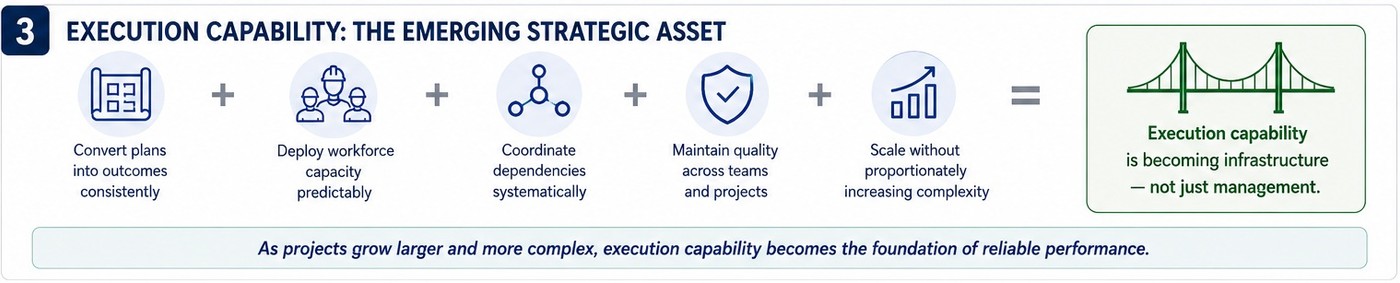
The ability to consistently convert plans into outcomes.
The ability to deploy workforce capacity predictably.
The ability to coordinate dependencies systematically.
The ability to maintain quality standards across multiple teams and projects.
The ability to scale without proportionately increasing complexity.
These capabilities rarely attract headlines.
Yet they increasingly influence project outcomes.
As labour markets tighten and projects become more complex, execution capability begins to resemble infrastructure rather than management.
Something that must exist before reliable performance becomes possible.
Betting On Capabilities Rather Than Predictions
The most enduring organizations often do not succeed because they predict the future perfectly.
They succeed because they invest in capabilities that remain valuable across multiple possible futures.
Toyota did not know exactly how the automotive industry would evolve over the following decades.
It did not know which technologies would emerge, which competitors would succeed, or how global markets would develop.
What it recognized was that superior execution capability would become increasingly valuable regardless of how those variables changed.
Construction faces a similar opportunity.
No one knows exactly how the industry will evolve over the next decade.
Artificial intelligence may accelerate.
Robotics may expand.
Labour markets may tighten further.
New construction methods may emerge.
The specific path remains uncertain.
What appears increasingly certain, however, is that reliable execution capabilities will become more important regardless of which future ultimately arrives.
The projects may change.
The technologies may change.
The business models may change.
The need to execute reliably at scale is unlikely to change.
Conclusion
Construction does not face a shortage of opportunity.
Across housing, infrastructure, industrial development, and urban expansion, the industry's long-term growth trajectory remains strong.
The emerging challenge is execution.
As projects become larger, schedules become tighter, labour becomes scarcer, and quality expectations continue to rise, execution capability is beginning to move from an operational concern to a strategic one.
The future leaders of construction may not simply be those who build the largest projects.
They may be those who develop the capabilities that make reliable execution possible across thousands of projects, teams, and locations.
Toyota did not become influential because it predicted every future development in the automotive industry.
It became influential because it invested early in a capability that the future increasingly required.
Construction may be approaching a similar inflection point.
The specific technologies, business models, and methods will continue to evolve.
But the need for reliable execution at scale appears to be moving in only one direction.
Increasingly, the industry's competitive advantage may depend not only on what it builds, but on how systematically it can execute.