
As Construction Scales, Reliability Becomes Its Operating Backbone
Construction has always depended on reliability.
A drawing must be reliable.
A schedule must be reliable.
A contractor must be reliable.
A supervisor must be reliable.
A worker must be reliable.
A material supply chain must be reliable.
But for a long time, reliability in construction was treated mainly as a project-level concern.
If a project was delayed, the schedule was reviewed.
If quality failed, workmanship was questioned.
If productivity dropped, labour availability was discussed.
If coordination broke down, supervision was increased.
These responses were understandable.
Construction is a difficult industry. Every project has moving parts, changing site conditions, multiple agencies, human variability, design changes, weather exposure, material dependencies, and commercial pressure.
The traditional construction operating model has survived because, in many situations, it works reasonably well.
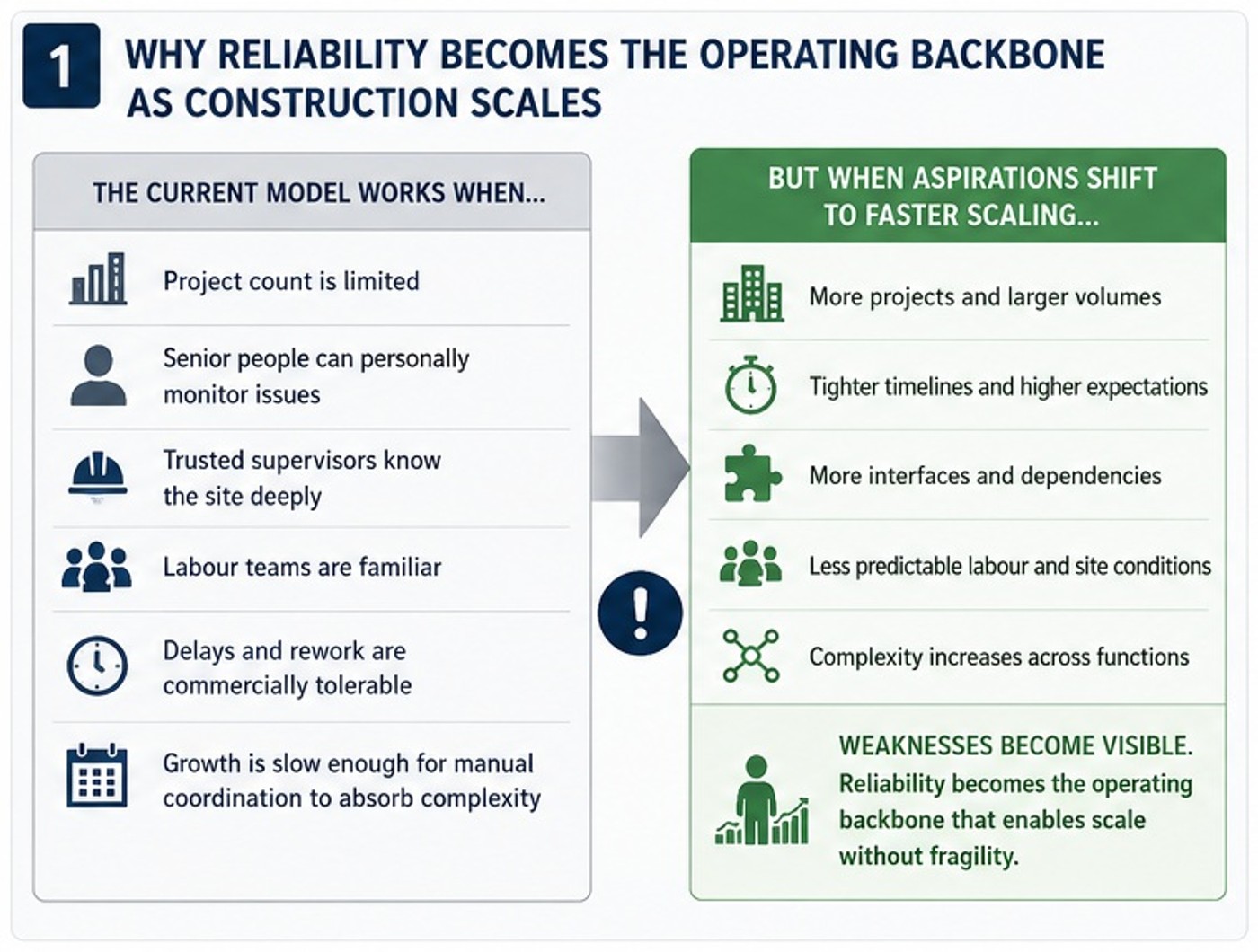
It works when the number of projects is limited.
It works when senior people can personally monitor critical issues.
It works when trusted supervisors know the site deeply.
It works when labour teams are familiar.
It works when delays and rework remain commercially tolerable.
It works when growth is slow enough for manual coordination to absorb complexity.
But once the aspiration is faster scaling, the weakness becomes visible.
When a company wants to manage more projects, tighter timelines, larger volumes, less predictable labour, higher quality expectations, and multiple execution interfaces, reliability can no longer depend on individual experience, personal follow-up, and reactive supervision.
At that point, reliability is no longer just an operating virtue. It becomes the operating backbone of scalable construction.
Because without reliability, scale does not simply create growth.
It creates fragility.
Construction Is Becoming More Interdependent
Modern construction projects are not just larger versions of older projects.
They are denser, faster, more coordinated, and more dependent on sequencing.
A delay in one activity can affect several others. Poor readiness in one area can reduce labour productivity in another. A quality defect can block handover, billing, finishing, customer readiness, or downstream work. Material delay can idle teams. Labour absenteeism can disturb a carefully planned sequence. Incomplete work by one agency can create waiting time for another.
In such an environment, reliability becomes more valuable because every activity depends on the dependability of previous activities.
A wall is not ready merely because the date has arrived.
A floor is not ready merely because manpower is available.
A project is not under control merely because progress is being reported.
Construction increasingly depends on the reliable conversion of plans into site-ready, measurable, quality-compliant work.
That conversion is where many projects struggle.
Reliability Is Usually Invisible Until It Fails
One reason reliability is under-discussed is that it is often invisible when things are working.
When work starts on time, nobody notices the system behind it.
When labour arrives as expected, nobody calls it a strategic advantage.
When quality is achieved the first time, it is treated as normal.
When material is available before execution, it is taken for granted.
When sequencing flows smoothly, it does not appear dramatic.
Reliability rarely announces itself. Failure does.
Delays announce themselves.
Rework announces itself.
Escalation meetings announce themselves.
Customer complaints announce themselves.
Cost overruns announce themselves.
Missed handovers announce themselves.
But these are often symptoms, not root causes.
A delay may be a symptom of unreliable readiness.
Rework may be a symptom of unreliable process control.
Quality variation may be a symptom of unreliable workmanship systems.
Low productivity may be a symptom of unreliable deployment.
Supervision overload may be a symptom of unreliable execution design.
This is why construction often treats the visible problem while the underlying reliability problem remains unresolved.
Reliability Is Not The Same As Quality, Speed, Or Labour
Reliability is closely connected to many construction outcomes, but it is not identical to them.
Reliability is not the same as quality. But quality depends on reliable execution.
Reliability is not the same as speed. But speed depends on reliable sequencing.
Reliability is not the same as labour availability. But labour productivity depends on reliable deployment.
Reliability is not the same as supervision. But supervision becomes more effective when the execution system is reliable.
Reliability is the condition that allows all these things to work better.
A project may have enough workers and still be unreliable.
It may have experienced supervisors and still be unreliable.
It may have detailed schedules and still be unreliable.
It may have strong contractors and still be unreliable.
Because reliability is not produced by intention alone. It is produced by systems.
Why Traditional Construction Models Struggle With Reliability At Scale
Construction has traditionally relied heavily on capable individuals.
Experienced project managers.
Strong site engineers.
Reliable supervisors.
Trusted contractors.
Skilled workers.
Long-standing vendor relationships.
These remain important. They will continue to matter.
But as projects scale, individual experience alone becomes insufficient.
The problem is not that people are not working hard enough. In many cases, construction professionals are already working under intense pressure. The problem is that too much reliability is expected to emerge from manual coordination, personal follow-up, informal memory, repeated phone calls, and reactive supervision.
That model has limits.
It works when scale is manageable.
It works when teams are stable.
It works when complexity is lower.
It works when the same experienced people can directly control the situation.
But when project size increases, labour becomes less predictable, agency interfaces multiply, and timelines compress, informal reliability starts breaking down.
Supervisors spend more time firefighting.
Managers spend more time escalating.
Teams spend more time waiting.
Workers spend more time shifting, correcting, or restarting.
Quality teams spend more time detecting defects after the fact.
In such situations, adding more supervision may help temporarily. But it does not fully solve the reliability problem.
Because reliability cannot be inspected into a project at the end.
It has to be built into execution from the beginning.
Reliability As The Operating Backbone – The Infrastructure
A city does not grow only because it has buildings. It grows because it has dependable infrastructure beneath daily life.
Power must be available.
Water must flow.
Roads must connect.
Communication networks must function.
Waste systems must operate.
People may not notice these systems every day, but the city depends on them.
Construction organizations are beginning to face the same operating reality.
To scale, they need more than projects, contracts, manpower, and machinery.
They need an execution backbone — infrastructure.
They need systems that make work predictable across sites, teams, and conditions.
This does not mean construction becomes rigid. Construction will always involve uncertainty. Every project has local realities. Every site has constraints. Every team has human variation.
But the presence of variation is exactly why reliability matters.
A reliable system does not eliminate uncertainty. It reduces the damage caused by uncertainty.
It creates a way to plan, prepare, execute, measure, correct, and learn without depending entirely on heroic intervention.
That is why reliability is becoming construction’s operating backbone.
It is the foundation that allows construction companies to absorb complexity without losing control.
The Hidden Tax Of Unreliable Execution
Unreliable execution creates a hidden tax across construction.
This tax does not always appear as a single line item.
It appears as waiting time.
It appears as rework.
It appears as idle labour.
It appears as repeated mobilization.
It appears as supervision overload.
It appears as material wastage.
It appears as poor handover readiness.
It appears as delayed billing.
It appears as strained client relationships.
It appears as margin leakage.
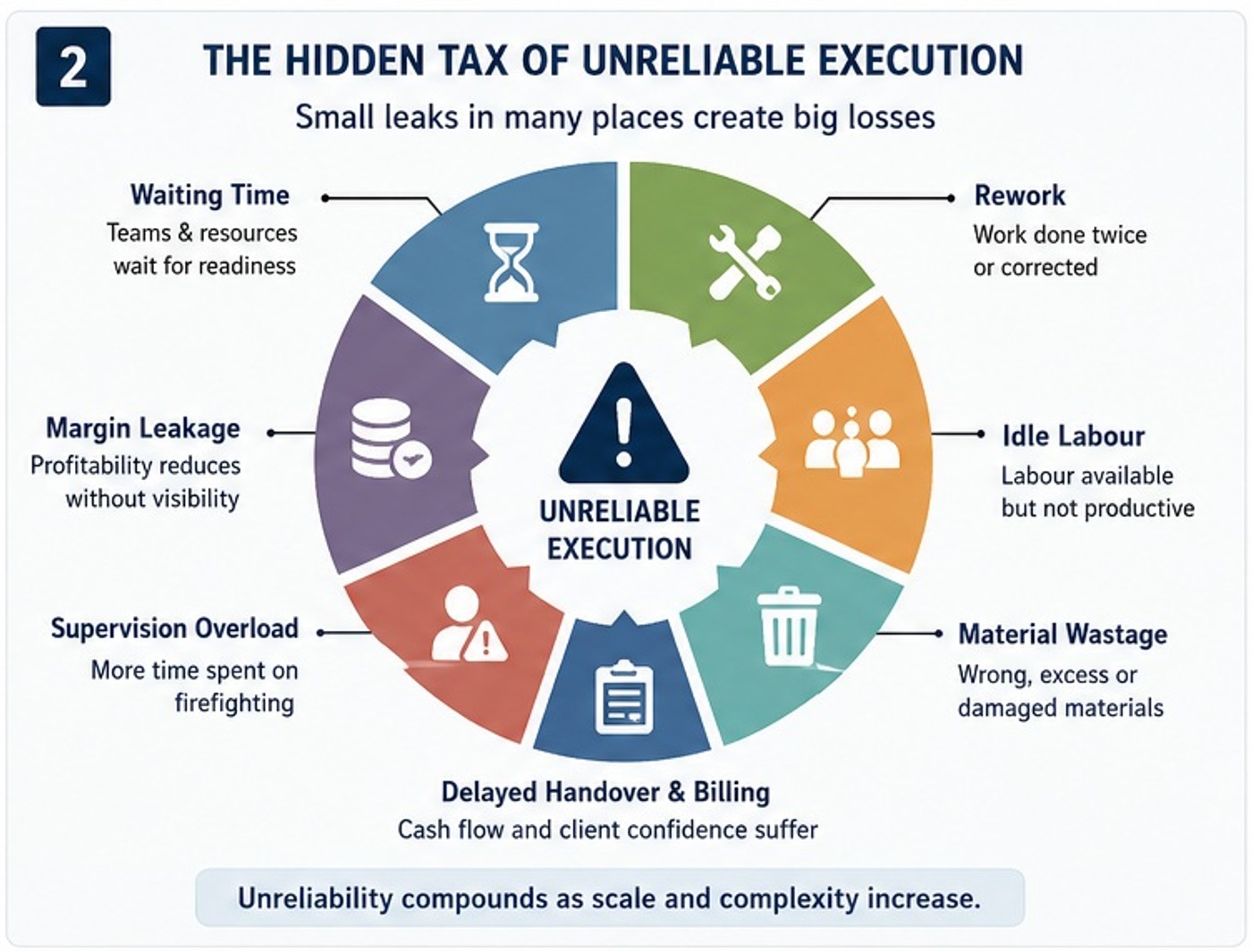
Each issue may look small in isolation. But together, they reduce the scalability of the organization.
A company may grow revenue and still become operationally weaker.
It may add projects and still lose predictability.
It may increase manpower and still see productivity decline.
It may invest in software and still struggle with site reliability.
This is the danger of scaling without execution reliability.
Growth amplifies both strength and weakness.
If the execution system is reliable, growth compounds capability.
If the execution system is unreliable, growth compounds disorder and chaos.
What Reliable Execution Requires
Reliable execution does not come from one tool, one dashboard, one supervisor, or one meeting format.
It requires several operating disciplines working together.
It requires clear standards so that work is not interpreted differently across teams.
It requires readiness checks so that work begins only when defined conditions are met.
It requires sequencing discipline so that one activity does not repeatedly disturb another.
It requires workforce readiness so that deployment is not just about headcount, but about skill, availability, fitment, and consistency.
It requires quality gates so that defects are caught early, not after they become expensive.
It requires measurement so that productivity, rework, delays, defects, waiting time, and handover failures become visible.
It requires feedback loops so that the system learns from what happened on site.
It requires governance so that deviations are not merely recorded, but acted upon.
These are not glamorous ideas.
But they are powerful because they create repeatability.
And repeatability is what allows scale.
Technology Can Help, But It Is Not The Starting Point
It is tempting to make reliability a technology discussion.
Dashboards, AI, sensors, BIM, project-management platforms, automation, robotics, and digital workflows will all have a role in the future of construction execution.
But technology cannot create reliability if the underlying execution logic is weak.
A dashboard can show delay. It cannot automatically create readiness.
AI can identify patterns. It cannot compensate for unclear standards.
Software can record defects. It cannot replace process discipline.
Robotics may improve productivity in certain tasks. But robotics also depends on predictable work conditions, defined inputs, and reliable sequencing.
Technology becomes powerful when it sits on top of a disciplined execution system. Without that foundation, technology risks becoming another layer of reporting over the same operational uncertainty.
The future of construction will not be built only by digitizing existing chaos.
It will require engineering reliability into the way execution is designed.
Reliability Will Become A Basis Of Competition
Construction companies have traditionally competed on cost, relationships, past experience, manpower access, technical capability, and financial strength.
These will remain important.
But another form of competition is emerging.
Execution reliability.
The ability to say, with confidence:
This work can be planned.
This capacity can be deployed.
This sequence can be controlled.
This quality can be repeated.
This timeline can be trusted.
This system can scale.
Reliability is not merely an internal operating metric. It means different things at different levels.
For developers and EPC leaders, reliability reduces uncertainty.
For project heads, it reduces firefighting.
For customers, it improves delivery confidence.
For investors, it improves scalability.
For workers, it creates clearer expectations and better operating conditions.
For the industry, it creates the foundation for higher productivity.
This is why reliability is becoming a strategic capability.
Toward Execution Engineering
The next stage of construction improvement may not come only from better project management.
Project management remains necessary. But project management often focuses on planning, monitoring, coordination, and control.
Execution reliability requires something deeper.
It requires designing:
How work actually happens.
How teams are prepared.
How activities are sequenced.
How quality is built in.
How productivity is measured.
How deviations are corrected.
How learning returns into the system.
How capacity becomes repeatable across projects.
This is where the idea of Execution Engineering begins to emerge.
Execution Engineering is not simply doing work. It is designing the system that makes reliable work possible.
If execution is becoming construction’s next frontier, reliability is the backbone needed to scale across that frontier.
And the construction organizations that understand this early may build an advantage that is difficult to copy.
Because reliable execution is not created overnight.
It is built through systems, standards, discipline, measurement, learning, and governance.
That is why, as construction scales, reliability becomes its operating backbone.